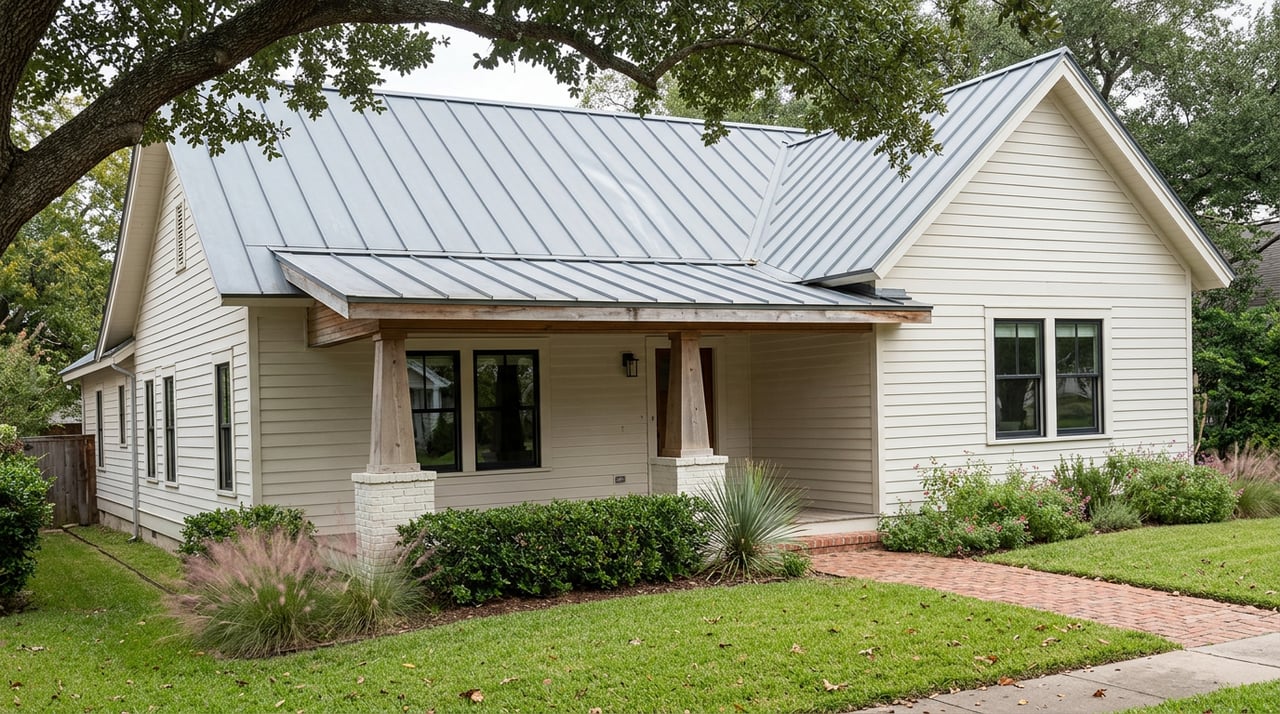
Picture two craftsman bungalows a few doors apart on Avenue G in Hyde Park, both with the deep front porches and low-pitched gables that define the neighborhood, both sitting on lots well under 7,000 square feet. Standing on the sidewalk, you'd have no way to tell which one could add a garage apartment without a fight and which one couldn't. The answer depends on a designation neither house wears on its face, and it has nothing to do with the citywide zoning reform Austin has spent the last three years publicizing.
That reform is real, and it is significant. It just doesn't reach very far into Hyde Park.
The Law Everyone's Talking About
Austin's HOME Initiative, rolled out in two phases starting in late 2023, rewrote the baseline rules for single-family lots across the city. The minimum lot size for a standard SF-1, SF-2, or SF-3 property dropped from 5,750 square feet, and Phase 2 pushed the small-lot threshold down to 1,800 square feet in many cases. Owners can now put up to three units on one lot without a variance. The old requirement that you live on the property to legally rent out an accessory dwelling unit is gone. Off-street parking minimums for ADUs disappeared in November 2023.
If you've been shopping for a house anywhere in Austin this year, you've heard some version of this pitch: smaller lots are buildable now, ADUs pencil out as rental income, and density that used to require a fight at the Board of Adjustment is by-right today.
Hyde Park is the neighborhood where that pitch runs into a wall built two decades before the HOME Initiative existed.
Hyde Park Opted Out Before Anyone Asked
The mechanism is a Neighborhood Conservation Combining District, or NCCD, a zoning overlay Austin has used since 1986 specifically to freeze certain neighborhoods against the kind of citywide liberalization that just happened everywhere else. An NCCD doesn't sit quietly underneath the base zoning code waiting to be updated. It overrides it. When the city loosens SF-3 rules citywide, an NCCD's own, older, narrower standard keeps governing the lot it covers, because that's the entire design of the tool.
Hyde Park's NCCD, adopted under Ordinance No. 020131-20, sets its own math: a minimum lot size of 7,000 square feet before a second dwelling unit is allowed, a height cap of 30 feet rather than the 35 feet permitted elsewhere, and a flat prohibition on garages facing the front of the lot. None of that changed when the citywide minimum dropped to 1,800 square feet. It couldn't. The City of Austin's own planning documentation is explicit that locally designated districts carry the strongest protection precisely because they aren't meant to move with every citywide code cycle.
Two Overlays, One Invisible Line at 45th Street
Here's where it gets genuinely confusing for anyone comparing two Hyde Park addresses, because the neighborhood isn't governed by one overlay. It's governed by two, split at 45th Street, adopted at different times under different logic.
South of 45th Street, the original Hyde Park NCCD applies, and since December 26, 2010, it's been layered under the Hyde Park Local Historic District as well. That second layer is the one that trips up buyers, because it adds a design review requirement the NCCD alone doesn't impose: any exterior change to a contributing structure needs a Certificate of Appropriateness from the Historic Landmark Commission before a building permit gets issued.
North of 45th Street, the North Hyde Park NCCD, effective August 29, 2005, sets its own density and height limits but was never paired with a Local Historic District designation. A homeowner north of the line can generally repaint, reroof, or replace windows without triggering a historic review process. A homeowner one block south of the line, on a lot that looks identical from the street, cannot.
| Citywide (HOME Act baseline) | Hyde Park NCCD (both halves) | Hyde Park Local Historic District (south of 45th only) | |
|---|---|---|---|
| Minimum lot size for a second unit | As low as 1,800 sq ft in many SF-3 cases | 7,000 sq ft | Governed by NCCD, not separately set |
| Height cap | Generally 35 ft | 30 ft | Reviewed case by case via Certificate of Appropriateness |
| Front-facing garages | Permitted under most base zoning | Prohibited | Prohibited under NCCD, plus design review |
| Exterior alteration review | None required by base zoning | None, unless also in the historic district | Certificate of Appropriateness required for contributing structures |
The Contributing and Non-Contributing Coin Flip
Inside the Local Historic District, there's a third distinction that decides how much friction a renovation will actually hit: whether a structure is classified contributing or non-contributing. Roughly 75 percent of the district's 640 properties, about 480 houses, are contributing, meaning they're at least 50 years old and were built during the neighborhood's period of significance, which the city's own preservation plan sets at 1892 to 1960. Those homes cannot be demolished except in extreme circumstances, and any exterior change needs Historic Landmark Commission sign-off. The remaining quarter of the district faces no such review at all.
This isn't an abstract distinction. In January 2011, Austin's Planning Commission heard a demolition request for what became known locally as the Bradford-Nohra House, a heavily altered wood-frame home the city's Historic Preservation Officer described as only "potentially contributing" to the district's historic fabric, according to reporting at the time in the Austin Monitor. It was the second time the commission had taken up the case, and members split evenly between preservation and the owners' request to tear the house down. The family pursuing demolition told commissioners they'd already spent more than $30,000 in legal fees trying to resolve the question. That's the real cost of not knowing a property's contributing status before you write an offer, not a hypothetical one.
What the Price Data Is Actually Telling You
If you've looked at Hyde Park's numbers recently, you've probably seen wildly different stories depending on which tracker you checked. One recent snapshot showed the median sale price around $808,000 in December 2025, up over 10 percent year over year, with days on market falling to 48 from 91 the year before. A more recent read from mid-2026 showed the median down more than 11 percent year over year over a similar window.
Both can be true at once, and neither is really a signal about direction. Hyde Park's historic core, the roughly 640 properties inside the district, sells at a pace of somewhere between 4 and 11 homes a month depending on the season. At that volume, one $1,699,950 sale like the five-bedroom on Caswell Avenue that closed in January 2026 or one $650,000 sale like the two-bedroom on Avenue C that closed the previous December can swing a median by six figures without the underlying market moving at all. The neighborhood isn't reversing course. It's small enough that any given month's headline number is closer to a coin flip than a trend line.
What This Means If You're Looking at Hyde Park
If a garage apartment, a rental unit, or future flexibility is part of why you're considering Hyde Park, the sequence that protects you is the same regardless of budget. Before you get attached to a listing, run the address through the city's Historic Property Viewer to confirm whether it sits in the Local Historic District, and check the GIS Property Profile Map to confirm which NCCD applies and whether the lot clears 7,000 square feet. Then find out if the structure itself is contributing or non-contributing, since that single classification determines whether a kitchen bump-out or a new dormer needs a Certificate of Appropriateness or just a standard permit.
None of this makes Hyde Park a harder place to own a home. It makes it a place where the renovation timeline and the ADU math depend on facts a listing photo can't show you.
A Few Questions Worth Asking Early
Does Austin's new HOME Act apply to my Hyde Park property? The citywide lot-size and unit-count changes apply everywhere in Austin's zoning jurisdiction except where a more restrictive overlay already governs. Hyde Park's NCCD is exactly that kind of overlay, so its own 7,000-square-foot second-unit minimum and 30-foot height cap still control, regardless of what changed citywide.
Do I need a permit to repaint my house or replace windows in Hyde Park? Interior work and routine maintenance generally don't require historic review anywhere in the district. Replacing windows, roofing, or making other exterior changes on a contributing structure south of 45th Street does require the Historic Preservation Office to weigh in before a building permit is issued.
What's the real difference between a National Register district and the Local Historic District? The National Register recognition Hyde Park received in 1990 is largely honorific and doesn't trigger a design review process on its own. The Local Historic District, effective in 2010, is the layer that actually requires a Certificate of Appropriateness for exterior changes to contributing structures.
Buying in a neighborhood with this much regulatory texture rewards having someone who's already read the ordinances, walked the boundary lines, and knows which side of 45th Street a given address falls on before you fall in love with it. If Hyde Park is on your list, The Holm Team can walk the property-specific details with you before you write an offer, not after. Schedule a personalized consultation and we'll help you separate what the city just changed from what Hyde Park never did.


